Identity & permissions
Actor roles, delegated authority and least-privilege permissions constrain what each person or service can do.

SECURITY / TRUST / GOVERNANCE
Ceryvra’s architecture is built around explicit authority, restricted access, evidence obligations, auditability and independent outcome verification—not unchecked autonomy.
PROTECTION THAT FOLLOWS THE WORK
From the first observation to the final verification, the platform is designed to preserve who had access, what evidence was used, who approved the action and what the systems actually reported afterward. This creates an auditable chain of accountability—not simply a log of clicks.
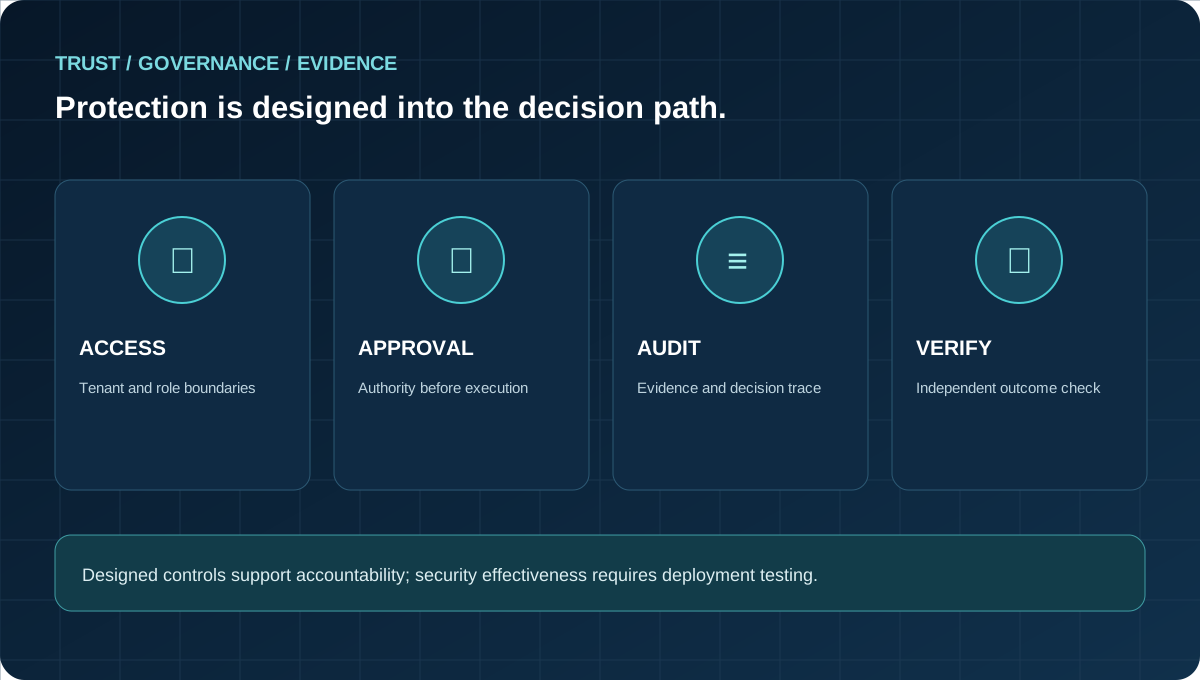
Illustrative control architecture. Operational effectiveness depends on deployment and independent security validation.
CONTROL AT EVERY STAGE
Observing an issue is different from approving a response. Recommending an action is different from executing it. Completing a workflow is different from proving that the intended outcome occurred.
Ceryvra’s design keeps those boundaries visible and makes governance part of the action lifecycle.
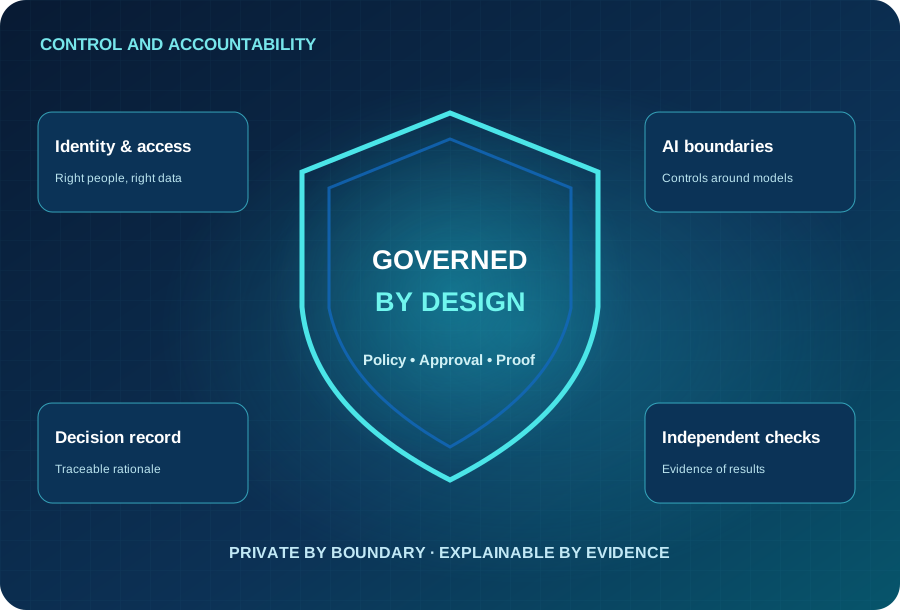
DESIGNED CONTROL PRINCIPLES
Controls are intended to follow the evidence, the decision, the authorized action and its verification.
Actor roles, delegated authority and least-privilege permissions constrain what each person or service can do.
Customer information remains separated, with access derived from authenticated identities instead of user-supplied headers.
Decisions preserve supporting records, required checks, missing information and changes that may demand revalidation.
Approvals, actions, state transitions and observed results retain a traceable history intended to resist tampering.
Observed system-of-record results are compared with expected outcomes, rather than trusting an execution acknowledgment alone.
Models may assist with analysis and proposals; they do not manufacture approvals, bypass policy or execute outside authorized boundaries.
THE CONVERSATION STARTS HERE
Connect with us to discuss governance needs, architecture and the applicable validation requirements.